Dallas Fort Worth Departures – DFW Airport
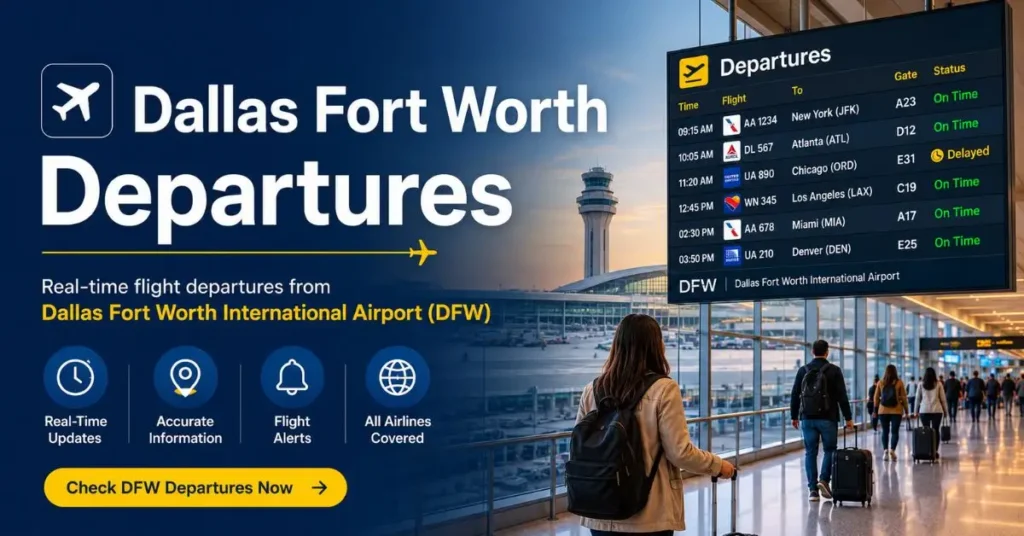
Passengers can avoid unnecessary delays by checking departure information at Dallas/Fort Worth International Airport (DFW) before arriving. As one of the busiest aviation gateways globally, the airport operates hundreds of daily DFW Departures across an expansive footprint. Real-time monitoring prevents missed flights, keeps you ahead of sudden schedule changes, and ensures you arrive at the correct gate without unnecessary terminal changes.
Quick DFW Departures Information
Before heading to the DFW Departure Gates at the airport, review these facts regarding the outbound operational structure.
| Attribute | Information |
| Airport Name | Dallas/Fort Worth International Airport |
| Airport Code | IATA: DFW / ICAO: KDFW |
| Airport Type | Public / Commercial Service (Large Hub) |
| Total Terminals | 5 operational passenger complexes (A, B, C, D, E) |
| Departure Flights | Over 900 peak daily outbound operations |
| Major Airline Hub | American Airlines (primary global mega-hub) |
| Time Zone | Central Standard Time (CST) / Central Daylight Time (CDT) |
Dallas Fort Worth Departures Overview
Navigating DFW Airport Departures requires an understanding of how the airport divides its massive traffic flow. Outbound operations are distributed systematically across five horseshoe-shaped terminals connected by a high-speed transit network.
The following table outlines the key details of DFW departures –
| Information | Details |
| Airport | Dallas/Fort Worth International Airport |
| IATA Code | DFW |
| Airport Type | Commercial Service / International Gateway / Large Hub |
| Terminals | A, B, C, D & E |
| Flight Types | Domestic Regional, Domestic Mainline, and International Long-haul |
| Major Hub | American Airlines Mainline and American Eagle Operations |
Information Displayed on DFW Departures Board
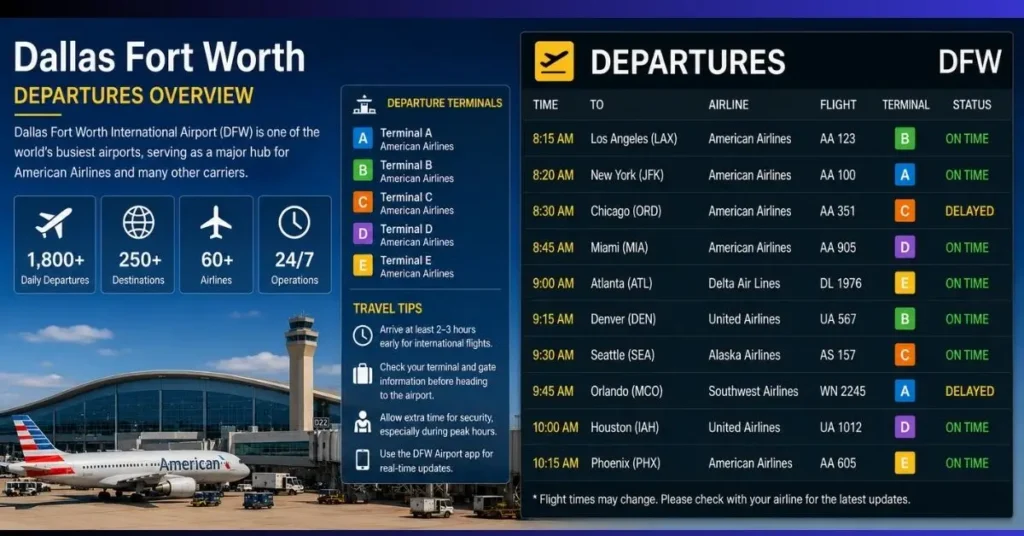
When checking a live online DFW Departure Board or reviewing terminal monitors, each column provides specific operational updates. Understanding these data points keeps your itinerary clear:
- Departure Time: This displays both the originally scheduled departure time and the estimated actual time. If weather or mechanical issues arise, the estimated time updates dynamically to show the realistic pushback window.
- Destination: The final city or primary connecting hub where the aircraft is heading.
- Airline & Flight Number: The alphanumeric carrier code identifying your specific flight (e.g., AA 1234 for American Airlines or QR 730 for Qatar Airways).
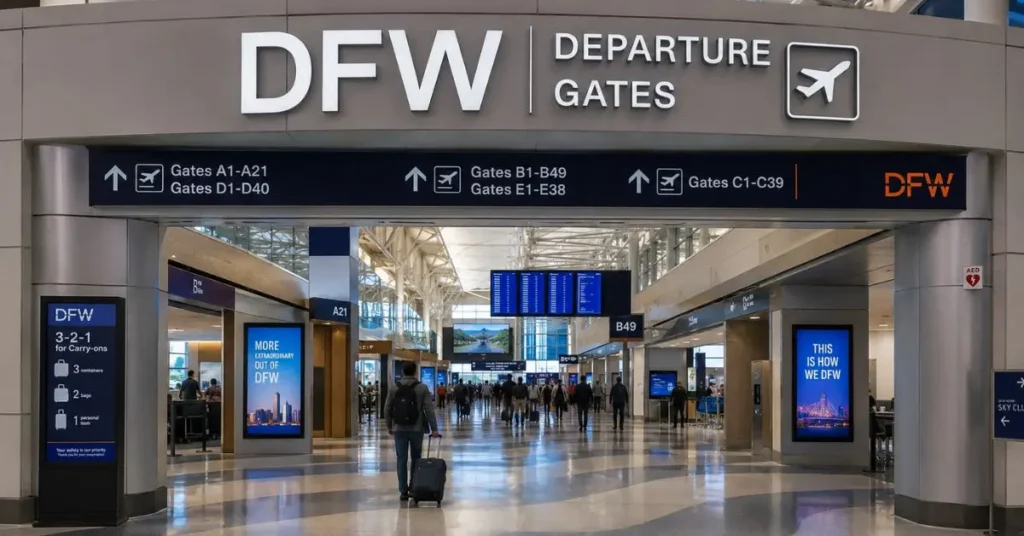
- Terminal & Gate: A precise physical boarding location at DFW. Because the airport terminals are distinct buildings, verify both the letter (Terminal) and DFW Departure Gates before security processing.
- Status: The current condition of your flight. Common statuses include On Time, Delayed, Boarding, Final Call, or Canceled.
Terminal Breakdown for DFW Departures
DFW Airport has five passenger terminals, each serving different airlines and flight operations. Confirming your DFW Airport Departures Terminal before arriving at the airport can help avoid delays and reach the gate more efficiently.
Terminals A, B, and C (Domestic American Airlines Hubs)
American Airlines operates most of its domestic flights from Terminals A, B, and C. Travelers departing from these terminals will find dedicated check-in counters, security checkpoints, and boarding gates for both mainline and regional services.
Terminal D (International Outbound Flights)
Terminal D functions as the main hub for DFW International Departures. It handles all long-haul international departures for foreign flag carriers, including British Airways, Qatar Airways, Emirates, Lufthansa, and Japan Airlines, alongside international itineraries operated by American Airlines.
Terminal E (Other Domestic Carriers)
Terminal E processes departures for all other major domestic and non-hub carriers operating out of North Texas. If you are departing on Delta Air Lines, United Airlines, JetBlue, Alaska Airlines, or Frontier Airlines, your trip begins here.
Passenger Services at DFW Airport Departures Terminal
Travelers using Dallas-Fort Worth Airport Departures can access a wide variety of terminal services throughout the airport, including areas beyond the security checkpoints.
- Free Wi-Fi: High-speed internet access is available throughout all public zones of the terminal.
- Charging Stations: Dedicated power hubs, USB outlets, and workstations built directly into gate seating areas.
- Airline Lounges: Premium spaces including American Airlines Admirals Clubs (Terminals A, B, C, D), the Capital One Lounge, and the Amex Centurion Lounge (Terminal D) are among the most prominent airline lounges.
- Nursing Rooms: Private, quiet spaces equipped with seating and power outlets for traveling parents.
- Pet Relief Areas: Dedicated airside and landside zones designed for service animals and pets.
- ATMs: Multi-bank automated teller machines located across all terminal concourses.
- Currency Exchange: Specialized kiosks operating primarily within Terminal D for international outbound banking.
- Lost & Found: Centralized service handling items left behind within the terminals or security checkpoint lanes.
- Accessibility Services: Wheelchair assistance, accessible transit vehicles, and participation in the Hidden Disabilities Sunflower lanyard program.
Transportation to DFW Airport Departure Gates
Departing passengers can access DFW’s terminal entryways through multiple ground transportation options:
- Private Vehicles: Directly access terminal drop-off lanes located on the upper levels immediately adjacent to check-in desks.
- Taxi: Dedicated taxi ranks drop passengers off outside the ticketing lobbies of all five terminals.
- Ride-share: Services like Uber and Lyft drop off on the upper ticketing level of your designated airline terminal.
- Rental Cars: The Rental Car Center is located off-site. A continuous 24-hour shuttle bus links the facility directly to all terminal departure areas.
- Public Transportation: The DART Orange Line connects downtown Dallas straight to Terminal A. The TEXRail commuter line links downtown Fort Worth directly to Terminal B.
- Hotel Shuttles: Regional airport hotels operate courtesy shuttle vans dropping off directly at designated terminal ground transport zones.
Dallas Fort Worth Departures: Facilities Available
DFW offers a variety of tailored airport parking models depending on your trip duration and convenience preferences:
- Terminal Parking: The closest option, situated directly adjacent to each terminal entrance. Terminal Parking utilizes digital overhead signage to guide drivers to open spaces and is ideal for short-term stays or fast drop-offs.
- Express Parking: Mid-priced lot options located near the north and south airport entry points. Passengers park their cars at Express Parking and board a dedicated shuttle bus directly to their departure terminal. Covered and uncovered options are available.
- Remote Parking: The most popular choice for extended travels. Remote Parking, which is farther from the main terminal area, depends on regular, direct shuttle service to get travelers to their ticketing gates.
- Valet Parking: In Valet Parking, drivers drop their vehicle off directly at the terminal curb, and it can be scheduled to await your return at a completely different terminal if your arrival flight changes.
DFW Airport Check-In & Boarding Guidelines
Arriving at the airport on time helps ensure a smooth departure experience.
| Flight Type | Recommended Arrival Time |
| Domestic Flights | At least 2 hours before departure |
| International Flights | At least 3 hours before departure |
Passengers should complete check-in, drop off any checked baggage, and proceed through security well before boarding begins. Most Domestic and International airlines close boarding approximately 15 minutes before departure for domestic flights and 30 minutes before international flight departures, although regulations may vary by airline.
Ways to Monitor Your Flight Status
Passengers can use several reliable methods to stay updated on their flight before departure.
| Channel | Tracking Purpose |
| Live Online Departure Board | View real-time departure status, delays, gate assignments, and cancellations. Best for pre-departure planning before leaving home. |
| Airline Mobile Apps | Receive boarding notifications, gate changes, and flight alerts. |
| Flight Information Display Screens (FIDS) | Check live flight updates throughout the terminal. Vital for physical confirmation once inside the airport. |
| Airline Customer Service | Get assistance with delays, cancellations, rebooking, or other flight-related inquiries. |
Staying ahead of your schedule is the key to a stress-free departure from Dallas Fort Worth International Airport. By checking live departure boards and verifying your specific terminal, you can easily avoid unnecessary terminal transfers. Arriving two hours early for domestic flights and three hours early for international departures gives plenty of time to drop off bags, navigate security, and locate boarding gates. Make sure to check your flight status and boarding gates before leaving the airport.
Frequently Asked Questions (FAQs)
The Dallas Fort Worth departures area is on Level 3 (Departures), near entry door D30.
You can view live departure information online or check the flight information display screens throughout the airport.
Arrive at least 2 hours before domestic flights and 3 hours before international departures.
Most international departures operate from Terminal D, while some airlines may depart from other terminals.
The departures board displays departure times, destinations, airline and flight numbers, terminals, gates, and the latest flight status.
Follow the updated gate information shown on the departure board, your airline’s mobile app, or the airport’s flight information displays.
Passengers can choose from Terminal Parking, Express Parking, Remote Parking, or Valet Parking based on their preference and travel plans.
Yes, TSA PreCheck lanes are operational at select checkpoints across all five terminals. CLEAR expedited identity verification lanes are also available at designated checkpoints in Terminals A, C, D, and E.
Walking between terminals landside (outside security) is generally not recommended due to the vast distances and roadway layout. Instead, use the free Terminal Link shuttle buses that stop at the arrivals level of each terminal outside security.